
Where skaters dare to go: from Niemeyer to the Guggenheim, when architecture opens its doors to skateboards
- Youth Magazine

- Mar 19
- 4 min read


Oscar Niemeyer’s curves weren’t designed to be skated. They were designed to free architecture from right angles, to bring the softness of Brazil’s rivers and mountains into reinforced concrete. Yet, in 2020, two skaters did exactly what no one had anticipated: they put their wheels on them.
Concrete Dreams: the facts
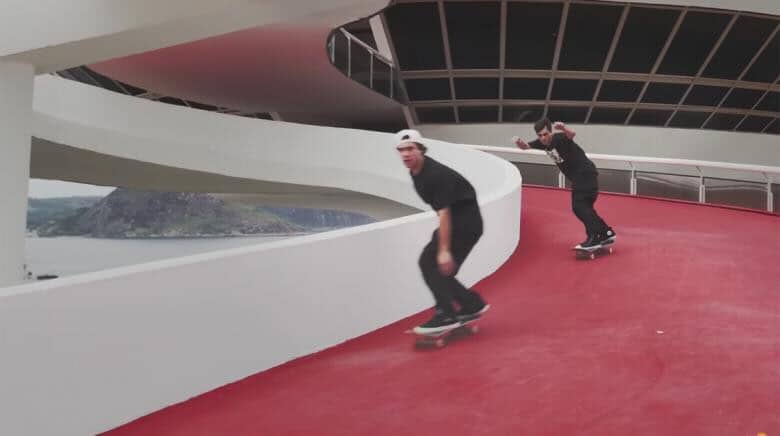
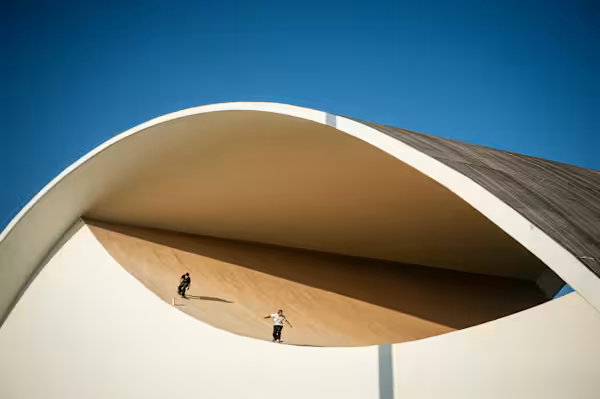
The project is called Concrete Dreams, a roughly fifteen-minute short film produced by Red Bull, in which Pedro Barros and Murilo Peres obtain permission to skate thirteen buildings designed by Oscar Niemeyer, including the National Congress in Brasília, the Museum of Contemporary Art and the Popular Theater in Niterói, the Administrative City of Belo Horizonte, and the Casa das Canoas in Rio de Janeiro. Structures normally inaccessible to the public, protected heritage sites, buildings conceived decades before skateboarding even existed. The film was made to mark the sixtieth anniversary of the inauguration of Brasília, the capital built in four years based on a design by Niemeyer and Lúcio Costa.
This was not an illegal incursion. Barros and Peres obtained authorization from the Oscar Niemeyer Foundation. Carlos Ricardo Niemeyer, the foundation’s executive director, openly acknowledged the connection between the two worlds. In his words, irreverence, freedom, the pursuit of challenges, and creativity in movement are as much a part of the essence of skateboarding as they are of Niemeyer’s work, characterized by free-flowing and surprising curves.
The pair studied the architectural drawings before filming to understand which lines and surfaces would lend themselves to riding. The result is a film in which the skater’s body becomes a tool for interpreting the architecture: the ramps of the MAC in Niterói become natural transitions, while the domes and walkways of Brasília transform into fluid sequences. The architecture is not violated; it is interpreted.
Pedro Barros and Murilo Peres: Who They Are
Pedro Barros, born in 1995 in Florianópolis, is no ordinary name in skateboarding. He holds the record for gold medals (six) and total medals (ten) in the Park discipline at the X Games. He won silver in the first Olympic skateboarding park event at Tokyo 2020. He is also an entrepreneur: he owns a beer brand, LayBack, and a fashion and lifestyle brand, Privê. Murilo Peres, the youngest of four brothers, was introduced to skateboarding at age ten and is a Brazilian national champion. Peres stated that Niemeyer used to say that architecture, like all art in life, must evoke feelings and experiences, and that on those concrete curves, millions of skaters have found their purpose in life.


When Architecture Opens Its Doors to Skateboarding
Concrete Dreams is not an isolated case. It is part of a broader trend in which skateboarding is welcomed—and no longer merely tolerated—within iconic architectural spaces.
In April 2023, Alexis Sablone became the first person to skate down the spiral ramp of the Solomon R. Guggenheim Museum in New York, the building designed by Frank Lloyd Wright. The event, documented in a short film directed by Jeremy Elkin, was carried out in collaboration with Converse and the museum itself, to mark the launch of the AS-1 Pro sneaker designed by Sablone. Sablone is an Olympic athlete, a seven-time X Games medalist, and holds degrees in architecture from Barnard and MIT. Her professional practice lies precisely at the intersection of skateboarding and the built environment: among her projects are the skateable sculpture Lady in the Square in the public square of Värnhemstorget in Malmö, and Candy Courts, a skatepark in Montclair, New Jersey.
A year later, in June 2024, Vans installed Checkered Future, a temporary concrete bowl at the foot of the Sacré-Cœur Basilica in Montmartre, Paris. The installation, designed by PlayLab and California Skateparks, was constructed of wood and foam painted to mimic the stone historically quarried from the site. It was not a provocation but an official event, coinciding with Go Skateboarding Day and the Fête de la Musique, featuring live skate sessions by the international Vans team and DJ sets by Justice and Kaytranada.
Skateboarding no longer enters through the window
Three projects differing in scale, geography, and production. But the thread is the same: in all cases, skateboarding does not burst into the architectural space but is invited in. The Niemeyer Foundation grants permission. The Guggenheim opens its doors. The Sacré-Cœur Basilica hosts a bowl at its base during Paris Fashion Week. Architecture ceases to be merely a backdrop or an obstacle and becomes a terrain for collaboration.
It is a significant shift. For decades, skateboarding built its identity in conflict with urban space—the security guard, the “No Skating” sign, the skate-stopper on ledges. That tension has not disappeared, and in many cities around the world, it remains the norm. But alongside it, a different door has opened. When a skater studies an architect’s drawings before entering a building, when a museum commissions a film documenting a descent down its own ramp, the relationship between the moving body and the built structure changes in nature.
Niemeyer wrote that he was drawn to free, sensual curves—those of mountains, rivers, and the beloved body. He had never thought of a skater. But perhaps the concrete already knew.


Comments