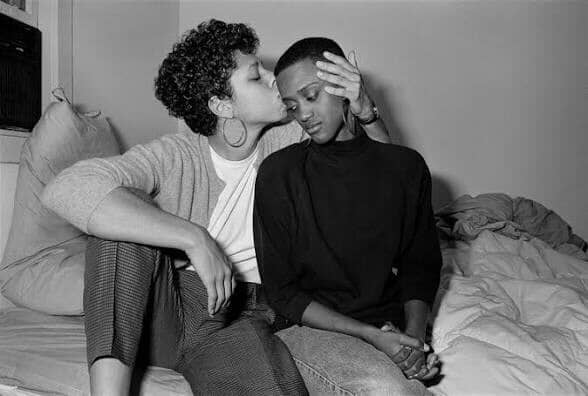
There is a photograph in which two women sit on the same sofa. They aren't doing anything extraordinary: one looks toward the lens, the other seems lost in thought. Around them is an ordinary room: books, objects, traces of daily life.
There is no grand gesture, no explicit declaration.
And yet, in that image, there is something that was still rare to see in the 1980s:
a same-sex couple existing, simply, in front of the camera.
Sage Sohier built her work exactly in this space. Not the space of the scene,
but that of normality.
Photographing the Invisible
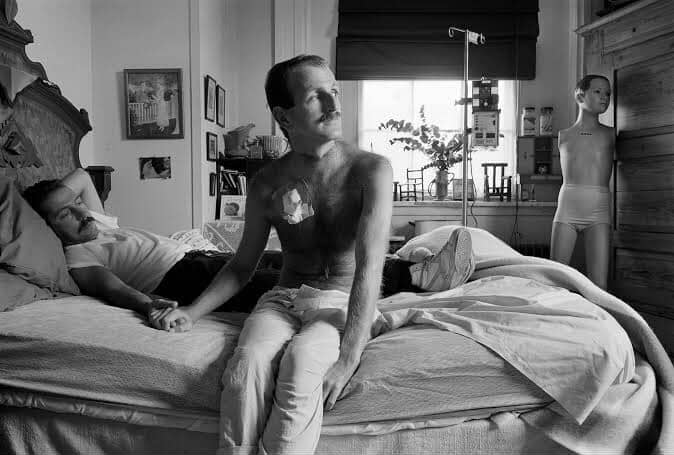
Between the late 1970s and the 1980s, Sohier traveled across the United States photographing same-sex couples in their homes. These were not portraits constructed to claim public visibility. There is no explicit activism in the imagery. Instead, there is something subtler: the recording of a reality that already existed, but was rarely represented.
Her photographs show domestic interiors, ordinary moments, minimal gestures. Two people sitting, a resting hand, a shared or avoided glance. Intimacy is not performed. It is not explained. It is simply there.
In a historical context where queer relationships were often marginalized
or invisible, this choice carries a specific weight.
Refusing to spectacularize becomes a stance in itself.
Intimacy as a Political Space
During the same years when other representations of queer culture moved through the night, clubs, and performance, Sohier worked in broad daylight. Her images do not seek the exceptional; they seek the everyday. This shift is crucial. It moves the focus from public visibility to private legitimacy. It is not just about being seen, but about being recognized as part of a possible normality.
The homes photographed by Sohier are not stage sets. They are lived-in spaces—often small, sometimes cluttered, always real. The domestic setting becomes the place where the relationship takes shape, away from the external gaze.
No Labels, No Captions
A central element of Sohier’s work is the absence of explanation. The images are not accompanied by detailed narratives; they do not guide the viewer toward a precise interpretation. There is no need to declare that these are couples. One senses it, perceiving it in the gestures, the distances, and the proximities.
This controlled ambiguity is part of the work’s strength.
It avoids simplification and leaves room for a slower reading. It does not impose
a category but shows a relationship.
In this sense, the photographs resist the contemporary logic of immediate definition. They do not name. They do not classify. They exist.
Before Recognition
In the 1980s, in the United States, same-sex couples had no legal recognition. Marriage equality would not arrive for decades. This means that many of the relationships photographed by Sohier existed in a gray area: real, perhaps stable, but devoid of official legitimacy.
The images thus become a form of visual existence. Not in a militant sense, but in the most direct way: making visible what would otherwise remain confined to the private sphere. It is a different kind of visibility from today’s. It is not amplified; it is not publicly claimed. It is discreet, almost restrained. But for that very reason,
it is radical.
A Silence That Sounds Different Today
For a generation accustomed to seeing queer representations widespread in visual culture—from fashion to cinema, from social media to advertising campaigns—
Sage Sohier’s work may seem quiet. Almost minimal.
But it is precisely in that silence that the distance is measured.
Today, intimacy is often shared, narrated, and mediated. In the 1980s, for many people, it remained a space to be protected. Sohier’s photographs do not break that boundary; they cross it with caution. They do not turn relationships into symbols. They let them be relationships.
To Exist, Without Explanation
Sage Sohier’s images do not construct a heroic narrative. They do not seek out exceptional moments. They work on something much harder to capture: normality when it is not yet recognized as such. Two people sharing a space, a life, a time. Nothing more, nothing less.
Today, that simplicity might seem obvious. Back then, it wasn't. And perhaps that is exactly what these photographs continue to convey: not so much what it meant to be visible, but what it meant to exist even without being so.






Comments