
Paris: Vintage on the Outside, Contemporary on the Inside
- Youth Magazine

- 1 day ago
- 3 min read
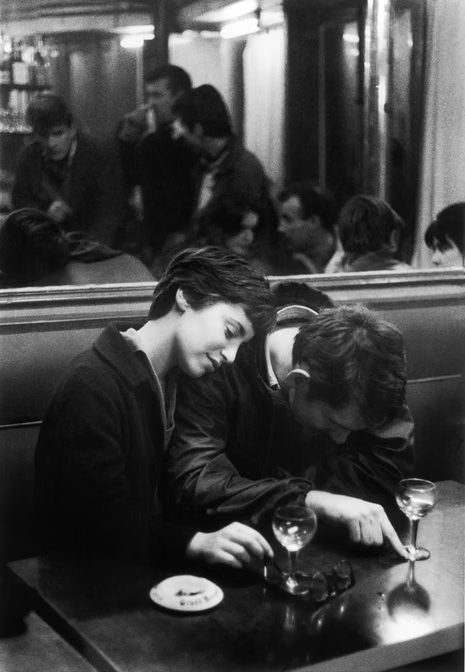
La Methode, Paris, 1960. Photograph:
Christer Strömholm
There are cities you have to describe, and then there’s Paris, which seems to tell its own story. You only need to walk a few blocks to feel like you’re inside a scene you’ve seen before: soft lights, retro signs, café tables that are always full, people talking for hours without haste. It’s not manufactured; it’s not a set. It is simply the way the city exists.
The beauty of it is that this vintage imagery isn't a tourist pose. It’s everyday life. It’s part of the real world for those who actually live in Paris. And this is exactly where something interesting happens: while everything seems frozen in time, the city remains profoundly contemporary.
An Artistic Myth That Never Fails
Paris has always had a special relationship with creativity. It’s not just a cultural capital; it’s a city where creating has always been natural, almost inevitable. In the cafés of Saint-Germain-des-Prés, figures like Jean-Paul Sartre and Simone de Beauvoir would meet, discussing philosophy, politics, and literature for hours. It was a way of experiencing the city that blended thought with daily life.
Today, that energy hasn't disappeared; it has transformed. Students, young artists, filmmakers, and digital creatives continue to use Paris in the same way: as a space where ideas take shape without needing justification. Here, being "intellectual" isn't detached from real life—it’s a core part of youth culture.

Style That Has Nothing to Prove
If there’s one thing Paris does better than anyone else, it’s style. But not in the most obvious sense. In neighborhoods like Le Marais, youth fashion moves between vintage shops, flea markets, and small independent brands. It’s not about following trends, but reinterpreting them. The result is what everyone recognizes as "effortless": outfits that look accidental but actually reflect a precise choice. A mix of second-hand pieces, curated details, classic elements, and personal touches. It’s a style that doesn't need to shout. It works precisely because it feels natural.
In a time when everything is hyper-visible and hyper-constructed, Paris continues to focus on something more subtle: identity.
The Luxury of Going Slow
Paris is not a city that rushes. Or at least, not in the way you’d expect from a major European capital. There’s a different rhythm in those French streets, made of long pauses, time spent observing, and days that don’t necessarily have to be filled. Sitting along the Seine, reading in a café, walking without a specific destination: these are simple gestures, yet they are central. This Parisian slowness isn't laziness; it’s a cultural choice. For Gen Z, accustomed to living among notifications, content, and constant speed, Paris offers a concrete alternative: the possibility of slowing down without feeling out of place. In this regard, the city becomes almost radical.
Nightlife Between Elegance and Creative Chaos
When evening falls, Paris changes its tone but never loses its balance. On one side, there are elegant venues; on the other, an underground scene that keeps reinventing itself. Places like Rex Club tell the story of this dual soul: electronic music and intense energy, but always with a certain aesthetic care.
The Parisian night is never completely chaotic, nor is it too controlled. It sits right in the middle. You can move from a quiet drink to a crowded dance floor seamlessly—changing the atmosphere without changing the city. It’s a nightlife that doesn't need excess to function. Its identity is enough.
Living Inside an Imaginary
One of the most unique things about Paris is how deeply it is tied to cinema, music, and visual culture. Not just because it has been depicted a thousand times, but because it continues to feel like a narrative in progress. Films like À bout de souffle (Breathless) built an aesthetic—that of the Nouvelle Vague—which still reflects in the city today. Movements, glances, rhythm: everything contributes to a specific feeling. The difference is that here, you aren't a spectator; you are inside it. The young people living in Paris don't just consume this imagery—they inhabit it, reinterpret it, and update it without destroying it.
The Past Becoming the Present
Paris never truly chased the future. It did something more interesting: it learned to coexist with its own past. Gen Z here doesn't reject the vintage aesthetic; they don't consider it outdated. They take it, mix it, and make it current. A 70s garment becomes contemporary, a historic café becomes a student hangout, and an iconic neighborhood keeps changing without losing its identity.
It’s a balance that is difficult to replicate. Because Paris didn't fall behind: it simply chose a different way to move forward.


Comments