

Derek Ridgers: Between Punk and New Romantic—London’s Tribes Before Global Fashion
- Youth Magazine

- May 14
- 3 min read
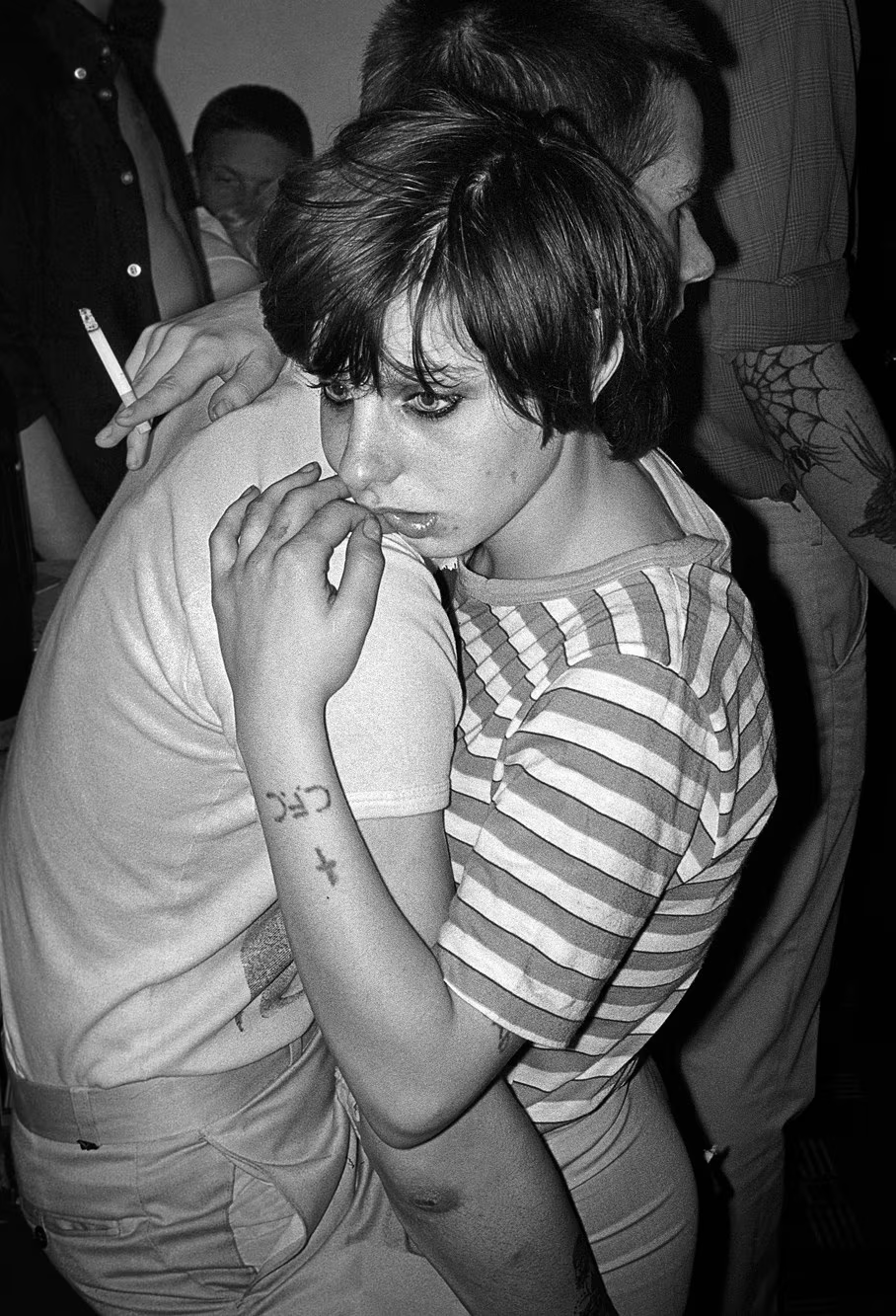
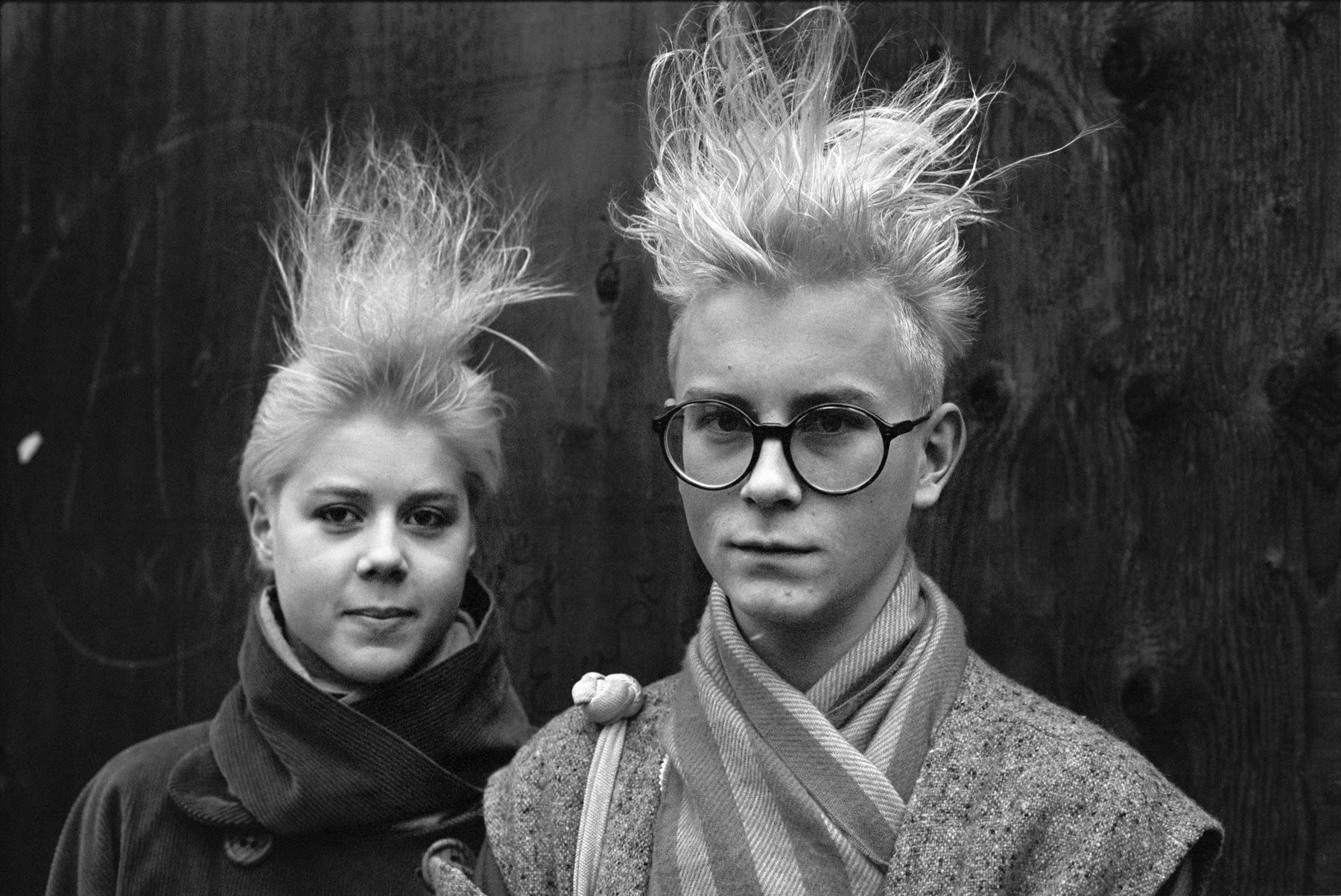
In Derek Ridgers’ photographs, there is a moment when style ceases to be mere surface and becomes a language. It is not fashion—or at least not yet. It is something more rigid and urgent: a code. A way to recognize one another, to declare oneself, to exist in public space without having to explain anything. London, early 1980s. Inside and outside clubs, on the streets, at concerts, on the fringes. That is where Ridgers builds his archive: not by observing subcultures, but by entering their boundaries.
Dressing to Belong
Ridgers’ images span worlds that we tend to separate today but that coexisted in the same urban ecosystem back then: punk, skinhead, new romantic, club kids. Each group has a precise visual grammar. Hair, jackets, shoes, details are not individual choices. They are legible signs, almost obligatory.
Punks construct their bodies as a rupture: leather, studs, rips, dyed hair. Skinheads, on the contrary, work through subtraction: shaved heads, bomber jackets, jeans, Dr. Martens. Clean, hard, almost military lines. In the clubs, the New Romantics emerge: makeup, flowing fabrics, theatricality, an aesthetic quest that moves away from the street to construct an elsewhere.
Ridgers photographs all of this with a direct gaze, without emphasis. He does not aestheticize, he does not judge. He records.
The Body as Uniform
What strikes one when looking at these images today is the radical nature of their coherence. Each individual is part of a larger visual system. The body becomes a uniform, but not in the sense of erasure. Rather, it is a form of collective statement.
Belonging to a subculture means accepting its codes, but also finding within those codes a space for identity. It is not a contradiction. It is the very functioning of those communities. In this sense, Derek Ridgers’ photographs speak less of style and more of social structure. They show how young people construct alternative systems of meaning to the dominant ones. Fashion, here, is not an industry. It is an internal language.
Violence, tension, reality
There is, however, one element that cannot be removed: tension. Some of these subcultures, particularly the skinhead subculture, are marked by complex dynamics, which also include violence and political conflicts. Ridgers does not make them explicit, but they are present, latent in the bodies, in the gazes, in the postures.
His images do not romanticize. They do not transform the subculture into a myth. They maintain a minimal distance, sufficient to convey reality without simplifying it. This is a fundamental difference from how these aesthetics would be reinterpreted in the years to come.
Before global fashion
Today, many of those visual codes have been absorbed. Punk has become a reference point, skinhead culture has been stripped of its original meaning and recontextualized, and New Romantic has entered fashion history. The symbols have survived, but the system that made them necessary has dissolved.
In Derek Ridgers’ photographs, however, everything is still functional. Every aesthetic choice has a precise, immediate meaning, shared by those who are part of it. There is no irony, no distance. There isn’t even the idea of being observed for an outside audience. It is a style that speaks to no one but those already in the know.
From physical space to the feed
For a generation raised on platforms where visual identity is constant, fluid, and modifiable, this kind of rigidity seems distant. Today, style is personal, hybrid, often temporary. References blend, update, and are quickly consumed. The subcultures of the 1980s worked the opposite way. They were slow, territorial, based on physical presence and direct recognition.
You couldn’t “try out” an aesthetic without truly entering it. And above all, you couldn’t easily leave.
What Remains
Derek Ridgers’ photographs are not merely documents of a historical moment. They are the visual trace of a system of belonging that is difficult to replicate today in the same forms. Not because subcultures have disappeared, but because the context in which they arise has changed. Public space, the city, and gathering places have lost that physical centrality that made such a clear distinction between inside and outside possible.
Yet, something remains. The need to recognize oneself, to express oneself through the body, to construct shared visual identities. The codes change, the speed changes, the medium changes. But the underlying idea of “dressing to exist” has never truly disappeared.


Comments