Along Interstate 40, somewhere between New Mexico and Arizona, a neon cowboy smiles into the void. His smile is intact; the paint is not. Below him lies a sun-cracked parking lot, a closed gas station, and an horizon dissolving into a white, motionless light. This is the America that Daniel Mirer has been photographing for thirty years: not the land of canyons at sunset and highways toward infinity, but the land of remnants—of what remains when the romantic gaze fades and the landscape returns to being exactly what it is.
Thirty Years Looking Where No One Else Does
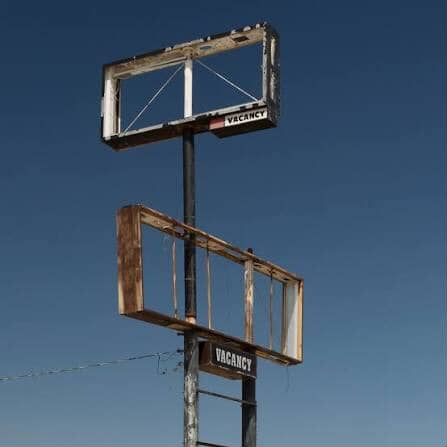
The project is titled Indifferent West. It has now become an exhibition at the Elliott Gallery in Amsterdam, accompanied by a book collecting 108 photographs taken over three decades. Mirer, a New Yorker, began traveling through the West in the 1990s during his studies at the California Institute of the Arts. Having grown up surrounded by the vertical imagery of Manhattan, he found an opposing kind of vertigo in the horizontality of the American desert: a space that nullifies the ego, a vastness that scales everything down. Yet, from the beginning, his lens focused on the fractures: faded motels, abandoned tourist attractions, empty swimming pools, and rusted billboards on the edges of semi-deserted roads.
Modernity’s Most Narrated Landscape
The American West is perhaps the most narrated landscape of modernity. From the 19th-century conquest to Hollywood mythology, from Manifest Destiny to Sergio Leone’s Spaghetti Westerns, that territory has functioned as a collective projection: the frontier as a promise, the open space as freedom. Mirer does not deny the power of that imagery but works through subtraction. His images do not shout. Captured in a square format, they frame the scraps of the dominant narrative: the points where myth crashes into reality, tourism into decay, and the postcard into drought.
A Square That Rejects Grandeur
The choice of the square format is not accidental. In a genre like American landscape photography, historically tied to the horizontal panorama, Mirer compresses the field of vision. The result is a gaze that does not embrace, but isolates. Each image becomes a circumscribed scene, a fragment that asks to be read with attention rather than admired with reverence.
The Desert Flowing Through the Feeds
There is a generational dimension to this work that goes beyond documentary photography. For those born in the nineties and the two-thousands, the American desert landscape is an omnipresent aesthetic code: from "desert-core" Instagram feeds to fashion campaigns set between Joshua Tree and Nevada, to road trips framed as spiritual experiences. Indifferent West short-circuits that surface. It doesn’t claim the desert isn't beautiful; it says that behind the beauty lies a history of colonization, extraction, and ecological collapse that the glossy image fails to tell.
The Method of Patience
Daniel Mirer explicitly places his work within the context of the Anthropocene. The West, in his words, embodies the complexities of this era: vanishing ice, drying basins, and resources extracted to the point of exhaustion. However, he is not a militant photographer in the traditional sense. His method is slow and layered. He returns to the same places years later; he walks, he waits. Some images are born by chance—a reflection on the asphalt, a heat mirage on the horizon. Others are the result of prolonged observation of the patterns through which tourism and industry transform the land.
He is not alone in rethinking the American landscape. Artists like David Benjamin Sherry, who reinvents the landscape tradition through color and a starkly queer identity, or Wendy Red Star, who weaves conceptual art with Crow culture, work on the same terrain from different angles. What unites them is the rejection of the landscape as a neutral backdrop. The territory is never innocent: it is always the result of political, economic, and cultural choices.
In the End, the Indifference Is Its Own
Indifferent West offers no conclusions. It doesn’t tell us how we should look at the American landscape, nor does it propose solutions. It does something more subtle: it shows what happens when one stops looking at a place through the filter of desire and begins to observe it for what it is. The desert, after all, never needed our stories. It was there before; it will be there after. The indifference, in the end, belongs to the land itself.







Comments